WhatsUp Us At 0086-136-87154886 Email: info@haoyu-autoparts.com


Home > Resources > Quality Assurance: How to Identify a Reliable Auto Parts Supplier in B2B Procurement
Quality Assurance: How to Identify a Reliable Auto Parts Supplier in B2B Procurement
- Lily Chen
- No Comments
Introduction
In the competitive automotive aftermarket, one wrong sourcing decision can lead to costly downtime, product recalls, or damaged reputation. For procurement managers, ensuring supplier reliability and consistent quality is the foundation of long-term success.
This guide explains how to identify dependable suppliers — like HaoYu Auto Parts Co., Ltd., a professional manufacturer of steering and suspension components — and what indicators reveal true quality assurance in B2B procurement.
1. Verify Core Certifications and Production Standards
A trustworthy supplier should hold internationally recognized quality certifications such as:
- IATF 16949 (automotive quality management)
- ISO 9001 (general quality control system)
- ISO 14001 (environmental management)
These standards confirm that the factory follows strict inspection processes, maintains traceable records, and applies continuous improvement.
Pro Tip: Ask for digital copies of the certificates and verify them with the issuing bodies.
2. Inspect Manufacturing Capabilities and Equipment
Reliable suppliers invest in advanced production and inspection systems.
Key signs include:
- Precision forging and CNC machining equipment
- Automatic assembly and robotic inspection lines
- Testing machines for hardness, torque, and lifespan
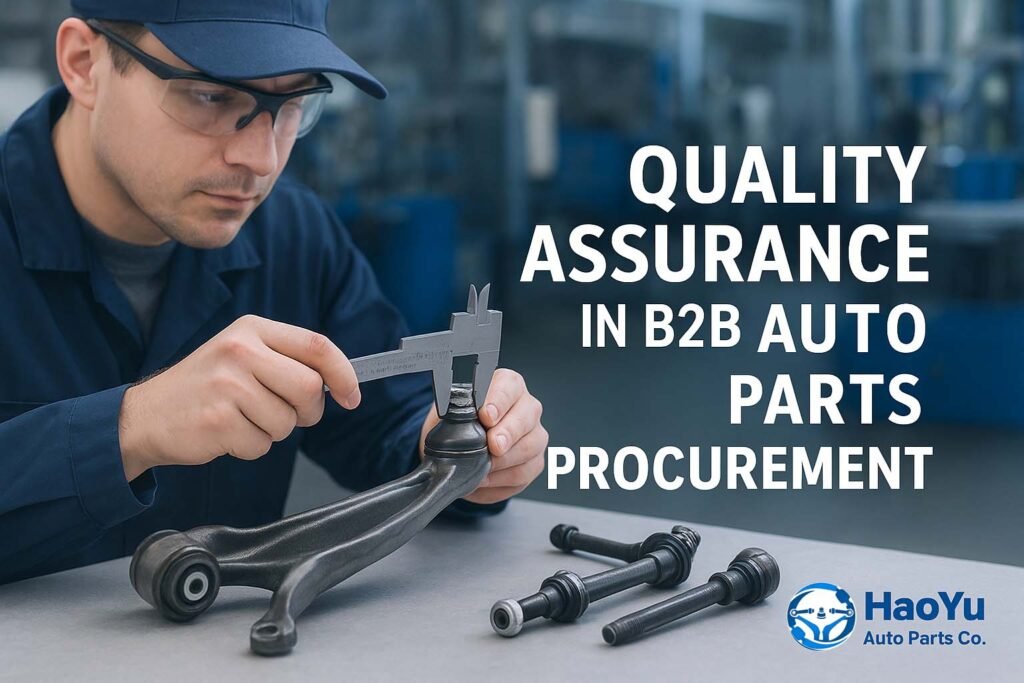
For instance, HaoYu Auto Parts uses precision measuring tools with micron-level accuracy to ensure every control arm, tie rod end, or stabilizer link meets OE standards.
3. Evaluate Material Quality and Traceability
High-quality materials are the backbone of product reliability.
Buyers should ask suppliers about:
- Steel grade and source (e.g., 40Cr, SCM435)
- Rubber compound durability
- Heat treatment and surface coating processes
Suppliers who can trace each batch of material from raw steel to final packaging demonstrate strong internal control and responsibility.
4. Review Testing and Quality Control Processes
A professional supplier provides detailed testing documentation for:
- Fatigue and endurance
- Salt spray (anti-corrosion)
- Dimensional and torque testing
HaoYu Auto Parts, for example, applies multiple inspections during production and 100% final testing before delivery to guarantee consistent performance.
5. Assess Supplier Transparency and Communication
Trustworthy suppliers are transparent with their data and responsive to buyer questions.
A quick response, detailed quotation, and willingness to share production videos or testing reports are strong indicators of reliability.
Good communication minimizes misunderstandings and builds long-term partnerships.
6. Visit or Audit the Factory When Possible
A physical or third-party factory audit reveals the truth behind the presentation.
Look for:
- Organized production workflow
- Clear labeling and traceability
- Skilled, stable workforce
A clean, well-managed facility often reflects the company’s professionalism and attitude toward quality.
Conclusion
Identifying a reliable B2B auto parts supplier goes beyond comparing prices — it’s about ensuring long-term quality, consistency, and trust.
Procurement managers should focus on verified certifications, transparent operations, and technical competence.
With its certified production systems, precision testing equipment, and clear communication culture, HaoYu Auto Parts Co., Ltd. is committed to helping global buyers build stable and high-quality supply chains in the steering and suspension industry.
MORE BLOG POSTS

Top Hubei NEV Chassis Parts Manufacturers List 2025 — Verified by HaoYu Auto Parts Co., Ltd.
The Rise of Lightweight Materials in Steering and Suspension Components